
Mathematics and weaving: learning across knowledge systems
TIPIAC • Ideas for educators
Explore pattern, space and measurement — with people, place and cultural knowledge at the heart of the learning.
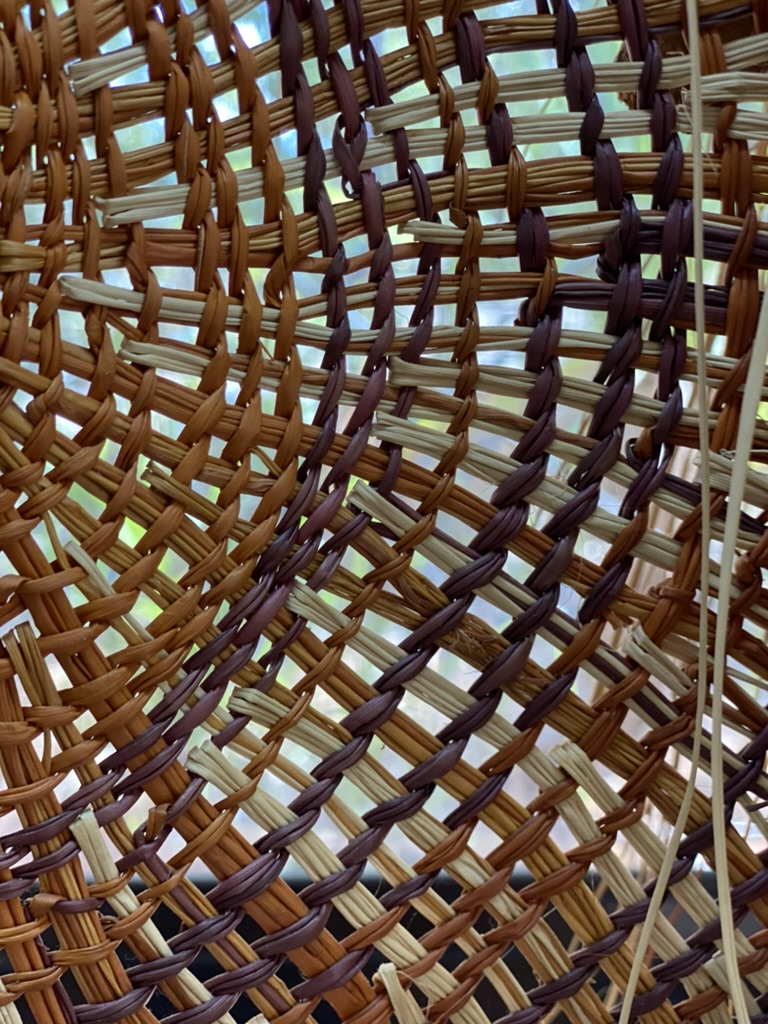
A strip passes over, then under. A learner predicts the next crossing, checks a pattern and adjusts the spacing. Mathematics and weaving offer educators a practical way to explore pattern, measurement, geometry and reasoning. They also invite a deeper question: whose knowledge are we learning from, and what gives that practice meaning?
For early years, primary and secondary educators, the learning can move between making, explaining and listening. At TIPIAC, we encourage educators to begin with people, place and purpose. Cultural knowledge deserves accurate attribution and context alongside the mathematical questions we bring to a lesson.
Weaving connects mathematical ideas with lived knowledge
In a simple classroom paper weave, learners can count crossings, predict a sequence, compare widths and reason about an array. Older students can express a repeating rule algebraically or investigate how area changes when a model is scaled. These are useful mathematical interpretations of a particular structure.
A cultural practice holds more than the visible pattern. Material selection, relationships with place, an object’s purpose and the ways people teach each other can be central to understanding it. School mathematics offers one language for discussing what we observe; a maker’s own explanation may organise and express that knowledge differently.
Ask learners to distinguish three things: what they can observe, what a source or maker actually tells them, and what they are interpreting. A repeated shape does not, by itself, reveal a cultural meaning. Nor does a classroom paper activity teach an entire cultural knowledge system.
Different practices need their own context
There is no single Aboriginal or Torres Strait Islander weaving tradition. Begin with a particular maker, community or organisation, and follow what they have chosen to share publicly. Avoid using one example to stand for every First Nations community.
Tjanpi Desert Weavers, a social enterprise of the NPY Women’s Council, describes native desert grasses used in contemporary baskets and sculptures, alongside other fibres such as raffia. This gives educators a starting point for discussing materials, shape and the relationship between an artwork and its context. It does not make a paper checkerboard a Tjanpi design.
Bula’bula Arts in Ramingining shares community practice that includes string bags and other art forms, with an emphasis on teaching younger generations. Explore an identified work and its maker-provided information. Check the actual technique before deciding which mathematical model is useful.
For a distinct comparison from Aotearoa New Zealand, Museum of New Zealand Te Papa Tongarewa describes Māori raranga as finger plaiting with strips crossing diagonally, used for objects including baskets and mats. Its materials and histories need their own attribution. Raranga, coiling, twining and loom weaving should not be presented as interchangeable processes.
Compare specific examples: materials, construction, purpose and what the sources say about learning. Let similarities open questions while keeping differences visible. Publicly viewable artwork is not automatic permission to reproduce a design or teach a cultural practice. Invite local guidance where appropriate, agree what may be shared and remunerate cultural practitioners for their work.
Early years: look, talk and play
For preschool children aged 3–5, start with a large picture and a short play invitation. Children can point, gesture, talk in home languages, move objects, draw or choose to watch. Reading, written answers and completed grids are not required.
- Explore long and short paper strips beside a picture of leaves.
- Put large soft objects in a safe basket and talk about in, out, full and empty.
- Bend, cross and arrange wide strips, following children’s ideas.
- Notice or change a simple repeated arrangement together.
The revised early years resource set has four large blackline discussion pictures, a Kakadu photo conversation and an educator observation page. It connects invitations with EYLF V2.0 Outcomes 4 and 5, with Outcome 2 connections through an identified maker and care for materials and place. Educators record the learning that actually happens and plan a responsive next invitation.
These generic illustrations and paper activities support discussion; cultural weaving practices need learning with appropriate makers and knowledge holders. The plant picture is not an identification or harvesting guide.
Primary: connect pattern with measurement
Investigate a model with six rows, eight columns and square cells of side 2 cm. With no gaps or border, the model has 48 cells, dimensions of 16 cm by 12 cm, an area of 192 cm² and a perimeter of 56 cm. Learners should explain the units and assumptions, then compare the model with their actual paper construction.
Shade alternate cells and reverse the starting colour on every row. Half the cells are shaded. Challenge students to test symmetry rather than assume it: this coloured six-by-eight checkerboard has no horizontal or vertical reflection symmetry, although a half-turn maps it onto itself.
Ask: What changes if our strips are wider? What can this grid tell us, and what can it leave out about fibres, making and cultural context? The primary set now separates Foundation–Year 2 picture patterns and direct comparison, Years 3–4 arrays and supported measurement, and Years 5–6 fractions, area, perimeter and symmetry. Choose tasks according to readiness.
Secondary: model, generalise and test
Number rows and columns from 1. In the classroom model, a crossing strip passes over when the row number plus column number is even, and under when the sum is odd. Students can test the rule, describe its repeating structure and decide when the two crossing types occur equally often.
For a rectangular model with m rows, n columns and square cells of side s, area is mns² and perimeter is 2s(m+n). Scaling every length by a factor of three multiplies perimeter by three and area by nine. Students should identify why real fibre objects may behave differently: widths vary, materials curve, and construction creates overlaps or gaps.
Pair this reasoning with source analysis. Which statements are supported by a maker’s account? Which are mathematical interpretations of the model? What would require further guidance? The secondary set separates Years 7–8 core rule-testing and substitution from Year 9 or extension work on algebra, scale factors and counterexamples.
Bring the learning into your setting
Start with an attributed public source, make an original classroom model, explain the mathematical reasoning, and return to the people and context behind the cultural example. This keeps the mathematical investigation connected to careful listening.
TIPIAC members can access the accompanying lesson and separate EYL, primary and secondary worksheet sets in the membership portal. The resources include educator guidance, a photo observation activity, lomandra outline illustrations, comparison prompts and worked answers. The paper-weaving grids are original classroom models.
Our basket close-up photographs were taken by Bronwyn Cochrane during a visit to Kakadu, NT, on 11 June 2022. The photography location does not identify the maker or plant species. Learners can observe the visible fibre structure while keeping those unanswered questions open.
For support developing culturally grounded practice across your setting, explore TIPIAC professional learning or our education services.
Plan your next lesson with Bilaarr AI
Bilaarr AI can help you develop ideas for this lesson or other lessons, adapt activities for your learners, and prepare questions and learning intentions. Try asking her: “Help me adapt this mathematics and weaving lesson for my year level, with an accessible activity and questions that distinguish observation from cultural source information.” Review her suggestions against your curriculum, trusted sources and local cultural guidance.
Don’t have access yet? Try Bilaarr AI free for 3 days — no credit card required and no obligation to sign up for a paid membership. The trial ends automatically after 3 days.
Sources and further learning
- Tjanpi Desert Weavers: Materials
- Bula’bula Arts: community practice in Ramingining
- Museum of New Zealand Te Papa Tongarewa: Raranga (plaiting)
Australian National Botanic Gardens: Lomandra longifolia
Sources consulted 14 October 2026. The classroom activities and diagrams are original TIPIAC teaching resources. They are not instructions for reproducing cultural designs or a substitute for learning with the appropriate knowledge holders.